
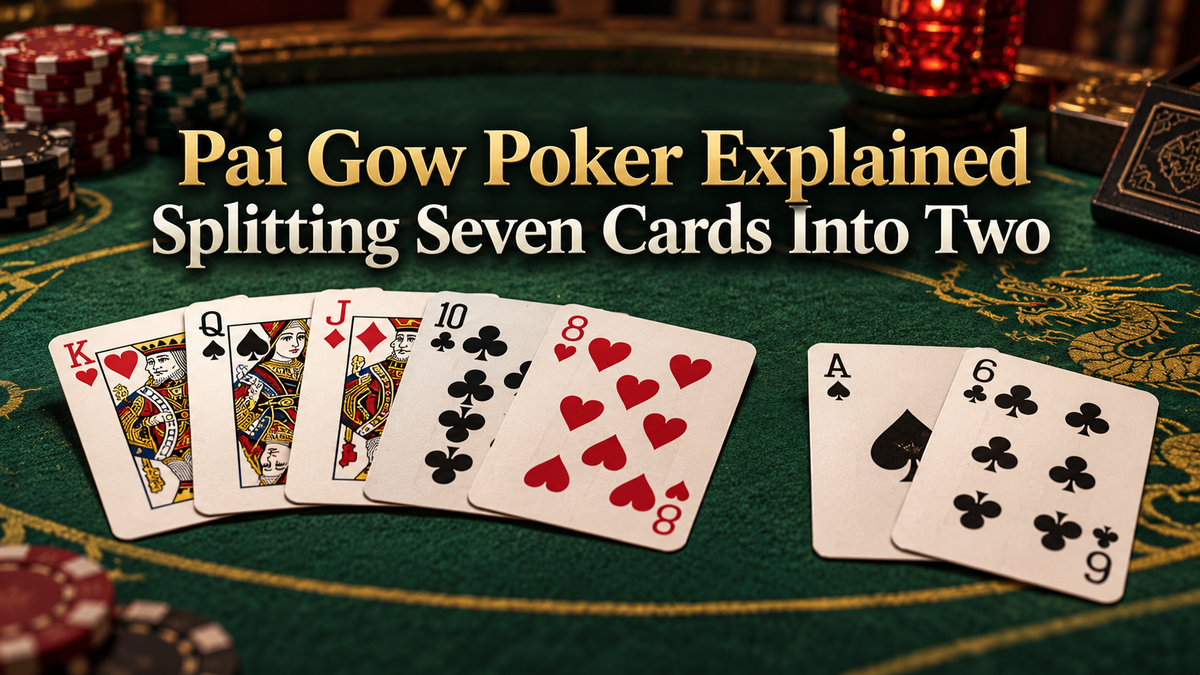
Pai Gow Poker deals every player seven cards, and your task is to split them into a five-card high hand and a two-card low hand. To win, both of your hands must beat the banker's matching hands. This guide explains the seven card split, the hand rules, the joker, and how a result is settled, so the unusual format becomes clear even if you have never played it.
Key Takeaways on Pai Gow Poker
- In Pai Gow Poker you receive seven cards and set them into a five-card high hand and a two-card low hand.
- The high hand must outrank the low hand, or the whole hand is a foul.
- You win only if both hands beat the banker's hands.
- If one hand wins and one loses, the result is a push.
- Ties go to the banker, and some tables charge a 5 percent commission.
Where Pai Gow Poker Comes From
Pai Gow Poker was created in 1985 by Sam Torosian as a card version of the traditional Chinese domino game pai gow. It keeps the idea of splitting your pieces into two hands but uses playing cards and poker rankings that most players already know.
The pace of Pai Gow Poker is slow and relaxed compared with most table games. Many results are pushes, so sessions tend to last a long time, which is part of the appeal of Pai Gow Poker.
The Seven Card Split in Pai Gow Poker
After the deal, you look at seven cards and arrange them into two hands. The high hand uses five cards and follows standard poker rankings. The low hand uses two cards and can only be a pair or a high card.
This split is the heart of Pai Gow Poker. A pair of aces and a strong two-card hand cannot both be built from the same weak seven cards, so every decision is a balance between the two hands.
High Hand and Low Hand Rules
The most important rule is that the five-card high hand must outrank the two-card low hand. If your low hand is stronger than your high hand, you have fouled, and the hand loses automatically.
In most casinos the ace-to-five straight, known as the wheel, counts as the second-highest straight. Check the table rules, because small variations in rankings exist from place to place.
The Joker
A single joker is added to the deck, and it acts as a limited wild card. In the five-card hand it completes a straight, a flush, or a straight flush when it can, and otherwise it counts as an ace.
In the two-card hand the joker always plays as an ace. This is why a hand with the joker often looks very different from a plain seven-card hand.
How a Hand Is Settled
Your two hands are compared with the banker's two hands separately:
- Win: both of your hands beat the banker's corresponding hands.
- Push: one of your hands wins and the other loses, and nothing changes hands.
- Loss: both banker hands beat yours, or your hand is a foul.
- Ties: a tied hand goes to the banker.
- Commission: some tables take 5 percent of winning payouts.
In Pai Gow Poker, because of the push rule, the outcome is often a push rather than a clear win or loss.
The House Way and Setting Your Own Hand
When the casino acts as banker, the dealer must set the banker's hand using a fixed set of rules called the house way. This keeps the dealer from gaining any strategic advantage.
You are free to set your own hand any way you like, as long as it is legal. Many players start with the simple approach of putting the best pair in the high hand and the next best cards in the low hand.
Simple Guidelines for Pai Gow Poker Hands
These steps help beginners:
- Look for the best five-card hand you can make first.
- Place the two leftover cards in the low hand and check the high hand still outranks it.
- With two pairs, split them between the hands when the pairs are low and keep them together when they are high.
- Avoid breaking up a strong hand just to improve the low hand slightly.
- Check the table rules for the joker, the wheel, and commission.
Pai Gow Poker: What to Remember
Pai Gow Poker asks you to split seven cards into a five-card high hand and a two-card low hand, with the high hand always outranking the low. You win only when both hands beat the banker's, and many results are pushes. Learn the table rules, set your hands sensibly, and play within a set budget.
This article offers educational information only and does not encourage anyone to play. If play starts to feel out of control, take a break and contact a support organization such as BeGambleAware.org.