
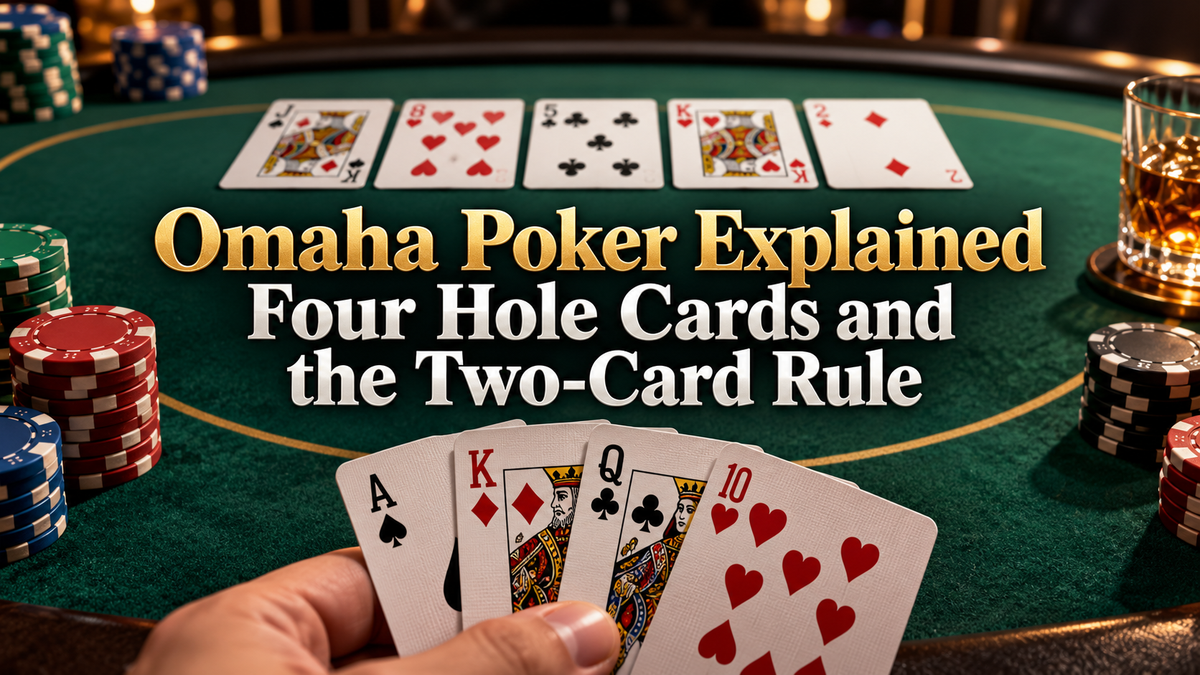
Omaha Poker deals each player four hole cards instead of two, and the best five-card hand must use exactly two of them. Pot Limit Omaha, often shortened to PLO, adds a cap that limits any raise to the size of the pot. This guide explains the four hole cards, the two-card rule, and how both change hand values, so a Hold'em player can follow the game with confidence.
Key Takeaways on Pot Limit Omaha
- Omaha Poker gives each player four hole cards, and five community cards come later.
- You must use exactly two hole cards and exactly three board cards.
- A raise is capped at the current size of the pot.
- In Omaha Poker, one pair rarely wins a contested pot, so strong hands matter more.
- Hands that aim for the best possible straight or flush gain value.
How Omaha Poker Is Played
Omaha Poker follows the same flow as Texas Hold'em: blinds, a pre-flop round, a three-card flop, a turn, a river, and a showdown. The big change is the number of private cards. Every player starts with four hole cards rather than two.
Five community cards are dealt face up in the center of the table. Rounds of action happen before the flop, after the flop, after the turn, and after the river, just as in the more familiar game.
The Four Hole Cards in Omaha Poker
In Omaha Poker, having four private cards means each player holds six different two-card combinations. In Hold'em there is only one. This makes the range of possible hands far wider and the showdowns stronger on average.
It also means your hand is more flexible. Four cards that work together, such as two connected cards and two suited cards, give you several routes to a strong finish.
The Two-Card Rule
The central rule is simple and often misunderstood. Your final hand must use exactly two of your four hole cards and exactly three of the five community cards. You cannot use one, three, or four hole cards.
This rule changes how you read the board. Four hearts on the table do not give you a flush unless you hold two hearts. A single heart in your hand is not enough, which surprises many new players.
Why One Pair Is Weak in Omaha Poker
In Omaha Poker, because each opponent has six possible combinations, the chance that someone has a better hand than your top pair is high. In a contested pot, one pair almost never wins, so experienced players look for stronger holdings.
As a result, hands that make straights, flushes, and full houses decide most pots. Beginners moving from Hold'em often overvalue a single pair and pay for it.
What Pot-Limit Means
In a pot-limit game, the maximum raise equals the size of the pot after you call. This creates a steady growth in pot size, and it sits between fixed-limit and no-limit play in terms of how quickly stacks are at risk.
The cap keeps the action from exploding as quickly as in no-limit, but the pot can still grow large over several rounds. Planning your stack across streets is an important skill.
Hand Quality in Pot Limit Omaha
Not all four-card hands are equal. Useful guidelines include:
- Connected cards: for example, a run of four close ranks supports many straights.
- Double-suited hands: two cards each in two suits create more flush chances.
- High pairs with side cards: pairs combined with suited or connected support.
- Dangling cards: a single isolated card often adds little value.
- Aim for the best possible hand, called the nuts, not the second best.
Hands where all four cards work together are generally stronger than hands with one loose card.
Common Beginner Mistakes
A few mistakes appear again and again:
- Playing too many hands because four cards look exciting.
- Using the wrong number of hole cards when counting a hand.
- Overvaluing one pair or a low flush.
- Ignoring the pot cap when planning a raise.
- Forgetting that opponents hold six combinations too.
Omaha Poker: A Clear Starting Point
Omaha Poker gives you four hole cards, demands exactly two of them in your final hand, and rewards strong, connected holdings. In the pot-limit version, raises are capped at the pot. Master the two-card rule first, then focus on hand quality and the best possible draws.
This article offers educational information only and does not encourage anyone to play. If play starts to feel out of control, take a break and contact a support organization such as BeGambleAware.org.